Why Human-in-the-Loop is the Foundation of Enterprise AI Recruitment


The global talent acquisition landscape has reached a critical inflection point. Driven by hyper-competition, shifting skill requirements, and the sheer volume of digital talent pools, enterprises are rapidly deploying artificial intelligence to optimise their hiring pipelines. The promise is undeniable: automated sourcing agents, instant resume parsing, and explainable AI match-scoring that can compress time-to-hire from weeks to hours.
However, as organisations rush to automate the employee lifecycle, a dangerous vulnerability has emerged. When AI systems are left to operate in a black box without structural human oversight, the risks are severe: hidden algorithmic bias, catastrophic compliance failures, and a cold, mechanical candidate experience that repels top-tier talent. High-profile automation failures, such as systems inadvertently penalising resumes containing specific diversity markers or algorithmic platforms running afoul of federal age discrimination laws, demonstrate that total automation in talent acquisition is not just a technical risk; it is a profound legal and cultural liability.
The solution is not to retreat from innovation, but to implement a superior architectural framework: Human-in-the-Loop (HITL) AI.
At Recruitment Smart, this is the core philosophy that powers our entire enterprise AI recruitment platform. We advise global talent teams that the future of hiring isn’t fully autonomous, nor is it purely manual. It is an integrated workflow where AI does the heavy analytical work while human recruiters retain final validation and strategic control.
By combining the processing velocity of advanced AI with the contextual, empathetic, and ethical judgment of human recruiters, enterprises achieve true scale without sacrificing corporate integrity.
1. Deconstructing the Spectrum: HITL vs. HOTL vs. AI-in-the-Loop
To build an effective talent acquisition strategy, organisations must move beyond treating "HR AI" as a singular, monolithic tool. Human-machine collaboration exists on a spectrum, and different stages of the recruitment lifecycle demand distinct levels of human intervention.
Human-in-the-Loop (HITL)
In a true Human-in-the-Loop architecture, the AI system acts as an analytical engine, but it is explicitly blocked from executing final actions or downstream processes without affirmative human validation. The human serves as a mandatory gatekeeper.
- Recruitment Core Use-Case: Candidate shortlisting, final selection tiering, and salary or offer formulation. The AI processes thousands of profiles and proposes a ranked selection, but no outreach or status change occurs until a recruiter manually reviews and approves the recommendations.
Human-on-the-Loop (HOTL)
In a Human-on-the-Loop framework, the AI platform operates autonomously at scale, executing tasks according to predefined parameters. However, human operators sit in an oversight position, monitoring the live telemetry of the process and retaining the absolute authority to intervene, override, or pause the system at any moment.
- Recruitment Core Use-Case: High-volume conversational sourcing campaigns and interview scheduling coordination. Autonomous agents converse with candidates to gather availability and answer policy queries, while recruiters monitor the dashboard to handle edge-case escalations or unusual conversational deviations.
AI-in-the-Loop
Here, the human recruiter remains the primary execution agent of the workflow, utilising AI purely as a static utility or productivity multiplier. The machine does not drive the process; it simply optimizes the inputs provided by the human.
- Recruitment Core Use-Case: Content optimisation, such as using generative models to refine a job description for search engine optimisation (SEO) or drafting personalised, ad-hoc follow-up emails based on a recruiter's specific notes.
Operational Matrix for Enterprise Talent Acquisition
2. How Recruitment Smart Solves the Feedback Loop Challenge
A common misconception is that keeping a human in the loop slows down automation. In reality, a well-engineered HITL architecture accelerates and refines machine intelligence through a continuous, three-stage feedback mechanism.
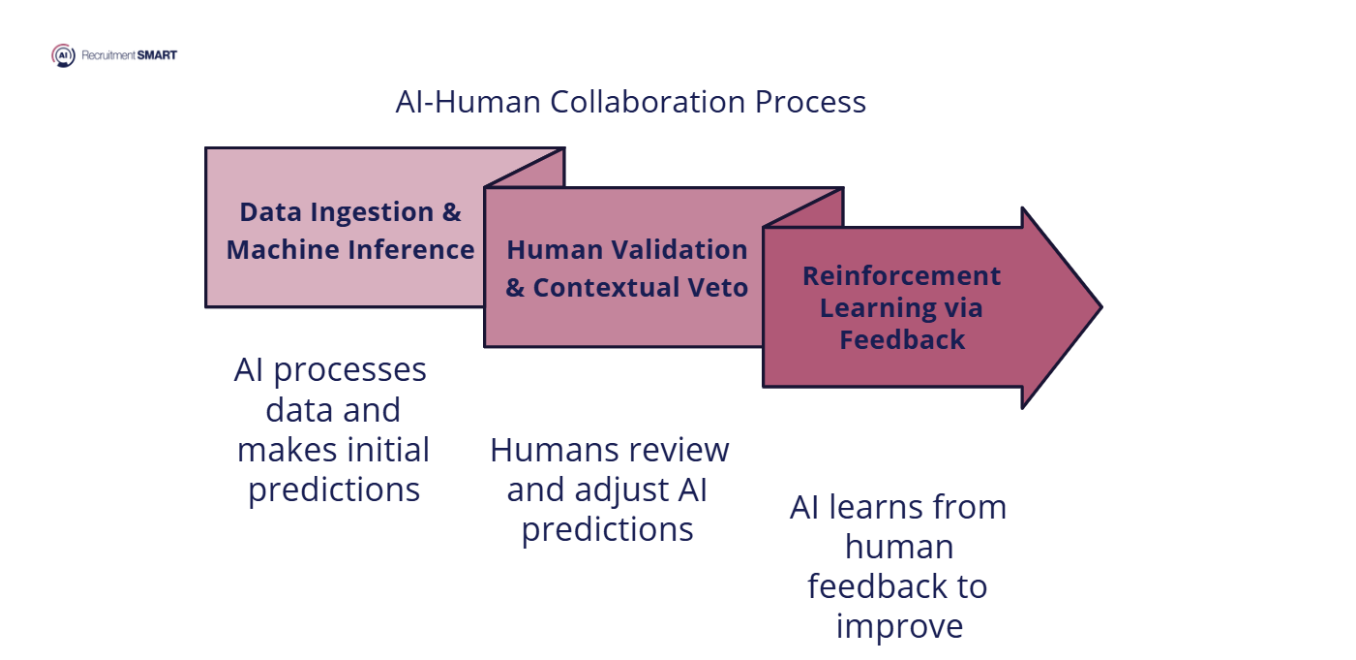
Phase 1: Ingestion and Machine Inference
The Recruitment Smart scanning engine ingests vast streams of structured and unstructured data across internal talent databases, job boards, professional networks, and portfolios. It applies semantic parsing to understand skills, adjacent competencies, and historical career velocity, cross-referencing this data against the enterprise job specification to generate an objective match-score.
Phase 2: Human Validation and Contextual Veto
The recruiter reviews the top-ranked candidates through our intuitive interface. This is where human intelligence excels: identifying non-traditional career paths, recognizing transferable skills that do not match standard keyword patterns, and evaluating soft skills indicated by structural narrative changes in a candidate’s career history. If a candidate is rated highly by the machine but lacks the qualitative leadership depth required for the role, the recruiter exerts a contextual veto.
Phase 3: Reinforcement Learning (RLHF)
Every action taken by the recruiter, whether an approval, a rejection, or a manual calibration of candidate ranking, is captured as a rich data point. Through Reinforcement Learning from Human Feedback (RLHF), our underlying models analyse the gap between machine prediction and human judgment. If the recruiter rejects a top-ranked candidate with a note regarding "insufficient organizational scale in previous roles," the algorithm adjusts its weightings for those specific requisitions pipeline, progressively eliminating false positives and tailoring its sourcing precision.
3. The Recruitment Smart Difference: What Makes Us Different?
Many talent acquisition platforms claim to support "human in the loop," but in practice, they use it as a euphemism for a fractured user experience. They force recruiters to perform endless manual reviews, click unnecessary approval buttons, and double-check basic data entry. This is not automation; it is just manual work hidden inside software.
Recruitment Smart approaches HITL differently across three fundamental pillars:
Deep Semantic Alignment Over Basic Keyword Matching
Legacy screening tools rely on strict keyword filtering. If a candidate leaves out an exact phrase, they are automatically rejected, creating massive false negatives. Recruitment Smart uses advanced contextual models that understand the meaning behind experience. Our platform evaluates adjacent competencies and career trajectories, presenting human recruiters with highly qualified talent who might have been missed by standard automated filters.
Dynamic Guardrails, Not Bottlenecks
We do not believe in slowing down your pipeline. Recruitment Smart applies automation where it belongs: handling scheduling, parsing data, and scaling outreach autonomously. Our human intervention points are strategically designed for high-impact decision nodes. The system flags exceptional profiles or potential compliance variances for human eyes, allowing the rest of the high-velocity pipeline to run smoothly.
Native Explainability (White-Box AI)
Most HR platforms operate as a "black box," providing a match score without explaining how it was calculated. This forces recruiters to either blindly trust the machine or ignore it entirely. Recruitment Smart features native explainability. Every recommendation comes with clear, readable data points showing exactly why a candidate was ranked a certain way, allowing human recruiters to make fast, fully informed decisions.
4. The Regulatory Shield: Compliance, Bias, and Global Governance
As global regulatory bodies increase scrutiny on algorithmic systems, a human-in-the-loop framework is no longer an optional best practice; it is an absolute corporate safeguard. Operating fully automated hiring systems exposes enterprises to unprecedented legal, financial, and reputational risk.
The EU AI Act and High-Risk Classification
Under the European Union’s landmark AI Act, artificial intelligence systems utilised for recruitment, candidate screening, and employment decision-making are explicitly categorized as High-Risk AI Systems. Article 14 of the Act mandates that these systems must be designed with appropriate human-machine interface tools to ensure they can be effectively overseen by natural persons during their operational period.
Recruitment Smart’s compliant HITL architecture directly satisfies this legislative mandate by providing:
- User Interfacing: Interfaces that display the rationale behind an AI match score, preventing the "black box" effect.
- Intervention Capabilities: Native mechanisms that allow an authorized HR professional to manually override or correct any automated output in real time.
- Auditability: Systematic logging of all human interventions, creating an unalterable audit trail for regulatory compliance reviews.
NYC Local Law 144 and EEOC Enforcement
In the United States, enforcement is intensifying at both the local and federal levels. New York City’s Local Law 144 requires stringent, independent bias audits for Automated Employment Decision Tools (AEDTs) used to screen candidates. Concurrently, the Equal Employment Opportunity Commission (EEOC) has launched comprehensive initiatives targeting algorithmic discrimination, holding employers strictly liable if an automated tool disparately impacts protected groups.
An AI engine operating without human oversight replicates historical biases present in training data. Our platform serves as a structural circuit-breaker. By enforcing a process where human recruiters review aggregated demographic distributions and validate automated shortlists before final progression, enterprises catch systemic anomalies before they manifest as illegal discrimination patterns.
5. The Paradigm Shift: Balancing Agentic AI with Strategic Control
The recruitment technology landscape is rapidly transitioning from traditional, rule-based automation to Agentic AI architectures. Unlike legacy Software-as-a-Service (SaaS) tools that require constant human prompting for every task, AI agents possess the capacity to plan, utilise tools, and execute multi-step workflows autonomously to achieve a high-level goal.
In this advanced environment, often referred to as Zero-Touch Hiring or agentic sourcing, the role of the human recruiter is fundamentally elevated. Recruiters are no longer administrative processors bogged down by manual scheduling, data entry, and keyword searches. Instead, they operate as strategic directors, managing an ecosystem of digital agents.
The workflow below illustrates how Recruitment Smart balances the infinite scale of agentic automation with the critical intervention gates of human oversight:
Step 1: Autonomous Pipeline Generation (AI Agent Scale)
The Recruitment Smart sourcing agent actively monitors and analyses global talent networks. It interprets complex talent availability trends, extracts deep skills profiles from non-traditional portfolios, and curates a comprehensive database of qualified passive talent, mapping out potential talent pipelines at a scale that would require hundreds of manual hours.
Step 2: The HITL Compliance Gate (Human Validation)
Before any external communication or campaign initiation occurs, the talent acquisition leader accesses the calibrated pipeline. The human reviews the machine's matching hypotheses, audits the structural diversity metrics of the pipeline, and verifies that the sourcing parameters align perfectly with the shifting strategic priorities of the business.
Step 3: Automated High-Touch Nurturing (AI Agent Execution)
Once approved by the human gatekeeper, conversational agents initiate highly personalised, context-aware outreach campaigns. The agent handles natural language interactions, answers candidate queries regarding corporate remote-work policies or insurance frameworks based on internal documentation, and matches calendar availability to coordinate initial assessments seamlessly.
Step 4: Strategic Evaluation and Offer Negotiation (Human Nuance)
With all administrative friction eliminated by our agentic layer, the human recruiter steps fully into their zone of unique value. They conduct deep contextual interviews, evaluate cultural integration, assess emotional intelligence, and build the critical human rapport required to successfully close top-tier enterprise talent in a competitive marketplace.
6. Elevating the Recruiter from Administrator to Strategist
The deployment of a Human-in-the-Loop AI framework does not reduce the necessity of human recruiters; rather, it amplifies their organisational impact. By delegating high-volume, process-driven data ingestion to advanced agentic systems, talent acquisition professionals are liberated from the operational quicksand of modern hiring.
The future of enterprise recruitment belongs to the augmented recruiter. Supported by Recruitment Smart's robust HITL architecture, talent leaders can transition into true human capital strategists. They can dedicate their expertise to building deep candidate relationships, advising executive leadership on long-term workforce planning, and ensuring that the organisation's hiring practices remain deeply ethical, transparent, and human-centric.
Implementing Human-in-the-Loop AI ensures that your organisation captures the profound competitive advantages of automation without losing the human core that defines exceptional talent acquisition.

%20(1).png)