
AI Job Description Generators vs Hiring Blueprint Platforms: What Enterprise HR Teams Need in 2026


Creating a job description has traditionally been one of the most time-consuming parts of the hiring process. Recruiters often spend hours gathering requirements from hiring managers, researching similar roles, defining responsibilities, aligning stakeholders, and revising drafts before a position is finally approved for publication. As hiring volumes increase and organisations expand across departments and geographies, this process becomes increasingly difficult to scale.
This is one of the reasons AI Job Description Generators have become one of the fastest-growing categories in recruitment technology. Solutions such as Recruitment Smart's Auto JD Generator can generate role-specific job descriptions in under 60 seconds, reduce time-to-publish by up to 80%, and improve job description consistency across departments by as much as 70%. These are meaningful productivity gains for talent acquisition teams operating in competitive hiring markets.
However, as AI-generated content becomes more accessible, enterprise HR leaders are beginning to ask a more strategic question: if every platform can generate a job description, what actually differentiates one hiring solution from another?
The answer lies in understanding a critical distinction. Creating a job description is only one stage of the hiring process. Defining the right role, identifying the right skills, evaluating candidates consistently, and making successful hiring decisions require a much broader framework. This is why forward-thinking organizations are starting to move beyond AI Job Description Generators and toward what we call Hiring Blueprint Platforms.
What Is an AI Job Description Generator?
An AI Job Description Generator is a tool that automatically creates a job description based on a small set of inputs provided by a recruiter or hiring manager. These inputs typically include the job title, department, experience level, required skills, location, and key responsibilities.
The system then generates structured content such as:
- Job summaries
- Key responsibilities
- Required qualifications
- Preferred qualifications
- Skills requirements
- Experience requirements
The value proposition is straightforward. Instead of spending hours drafting and editing a role description, recruiters receive a structured draft within seconds. This allows teams to move faster, standardise content, and reduce the administrative effort associated with creating job postings.
For many organisations, this is a significant improvement over traditional methods. However, it is important to recognize that generating a job description is not the same as designing an effective hiring process.
Why Are HR Teams Investing in AI Job Description Generators?
The popularity of AI Job Description Generators is driven by a genuine business need. Recruitment teams are under pressure to fill roles faster while maintaining candidate quality and hiring consistency. At the same time, hiring managers expect quicker turnaround times and greater support from talent acquisition teams.
AI helps address these challenges by automating one of the most repetitive parts of recruitment.
Common Challenges AI Helps Solve
These efficiencies are valuable. However, they only address one part of the hiring workflow.
What Happens After the Job Description Is Generated?
This is where the conversation becomes more interesting.
Most vendors focus on how quickly a job description can be created. Enterprise HR leaders, however, are increasingly concerned with what happens after the document is approved and published.
A job description is not the final output of hiring. It is the starting point.
The moment a role is published, recruiters must begin sourcing candidates, screening applications, conducting interviews, evaluating fit, and making hiring decisions. If the underlying role definition is weak, every stage that follows becomes more difficult.
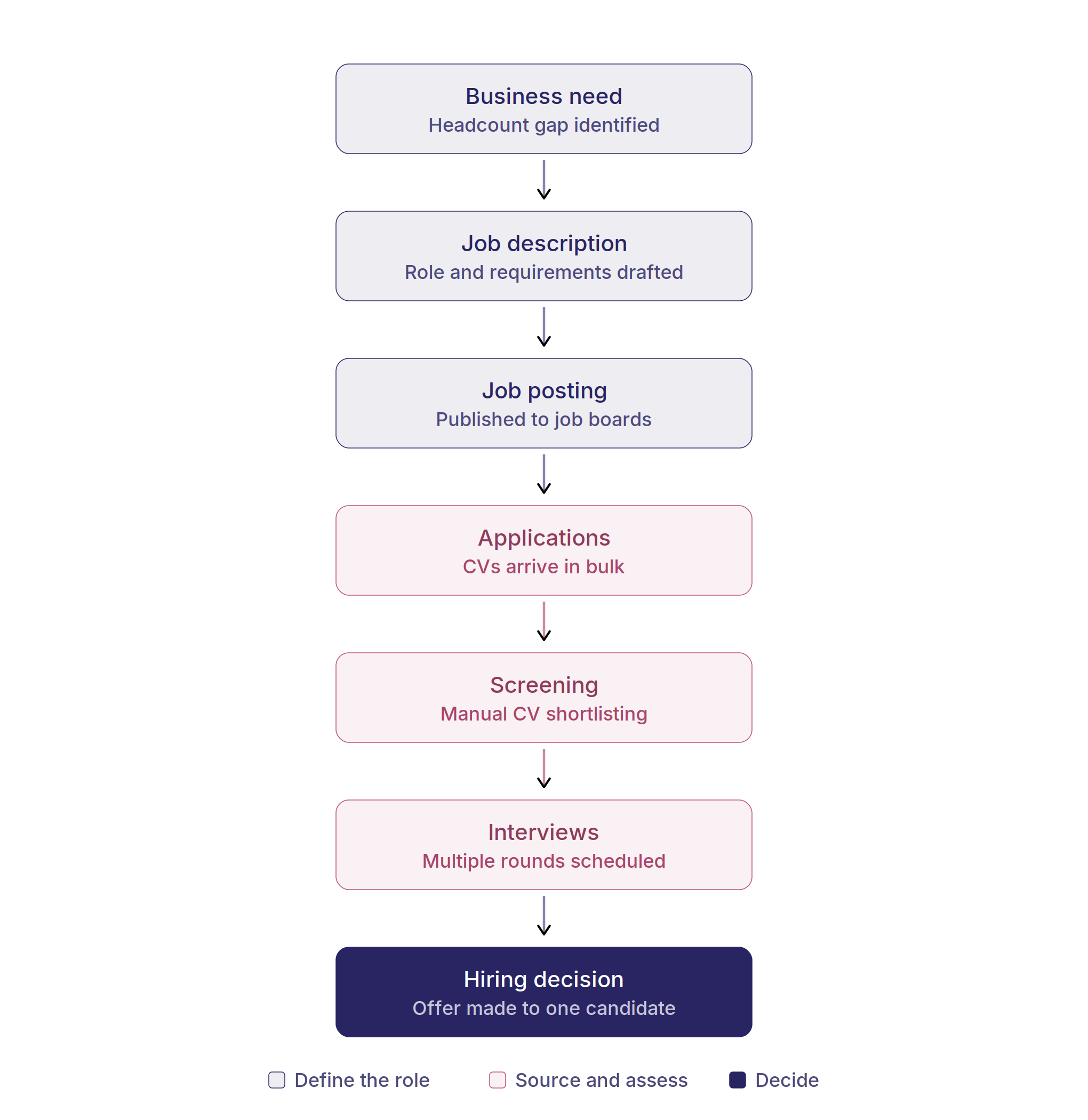
Traditional Hiring Flow
Modern Hiring Flow
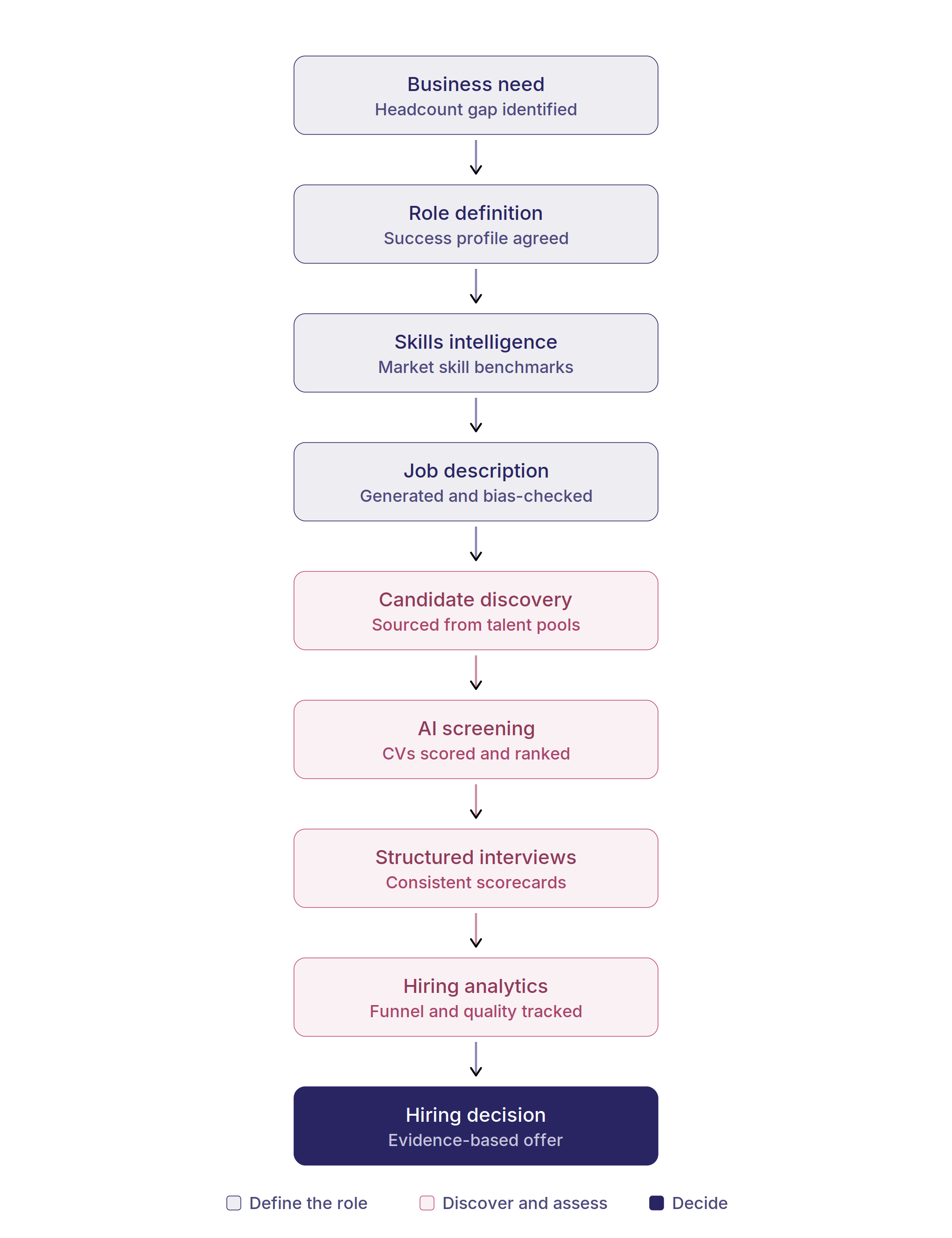
The difference between these two approaches is substantial. One focuses on creating a document. The other focuses on creating a hiring system.
The Hidden Cost of a Poor Job Description
Many organisxations underestimate the impact that role definition has on hiring outcomes. A poorly defined role often creates problems that are incorrectly attributed to sourcing, screening, or interviewing.
Consider a common scenario. A hiring manager requests a Senior Data Engineer and provides a list of requirements. The role is published quickly, but candidate quality remains inconsistent. Recruiters struggle to identify the right profiles, interviewers evaluate candidates against different criteria, and hiring managers continue changing requirements throughout the process.
At this point, the organisation does not have a sourcing problem.
It has a role-definition problem.
A Poorly Defined Role Creates a Domino Effect
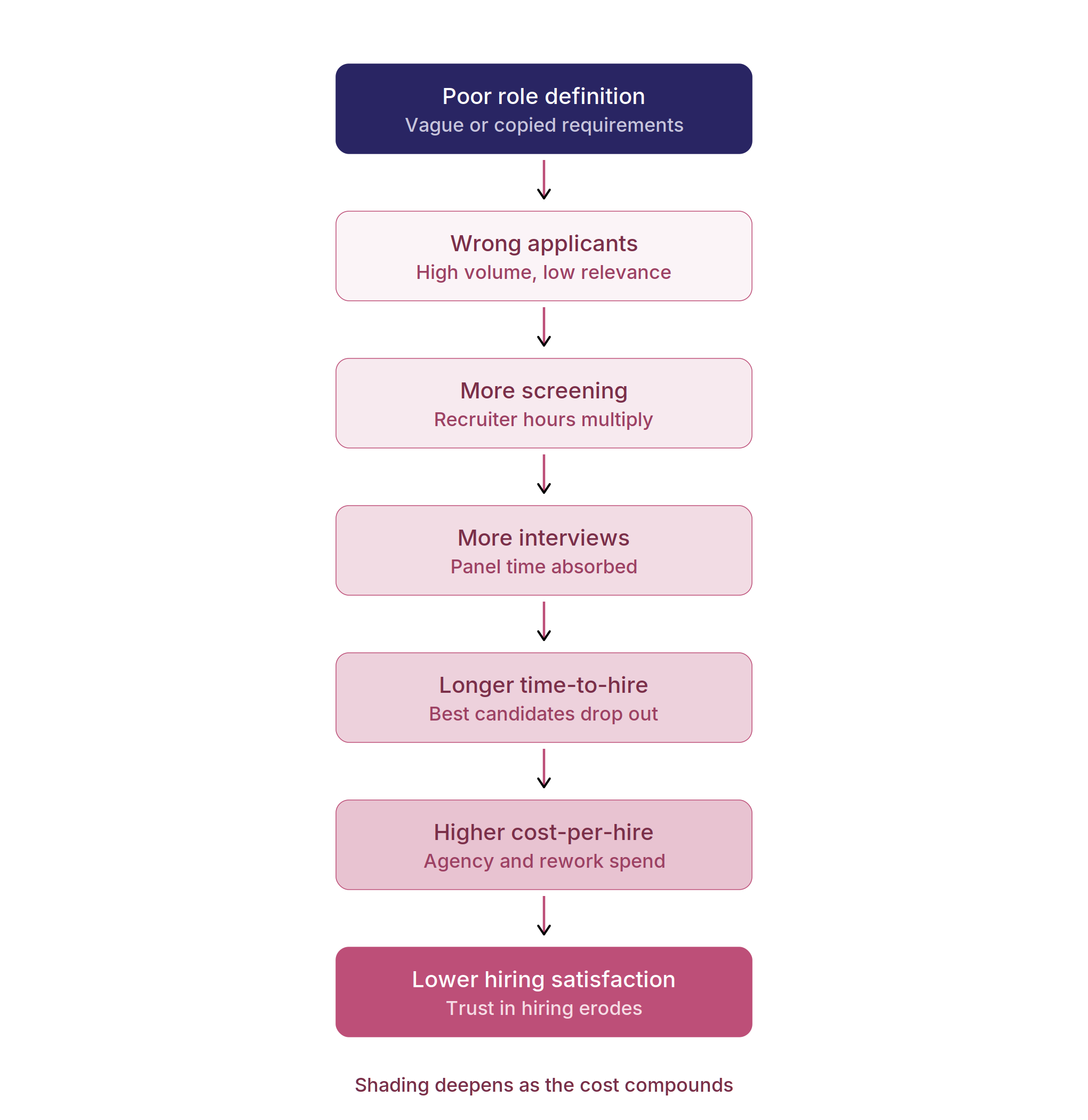
This is why the quality of the role definition matters just as much as the quality of the job description itself.
Why Most AI Job Description Generators Stop Too Early
One of the most common objections recruiters raise when evaluating AI powered hiring technology is simple:
"Why can't I just use ChatGPT?"
The question is reasonable because modern AI models are capable of generating high-quality text. However, enterprise hiring requires far more than content generation.
Recruiters and hiring managers still need answers to questions such as:
- Which skills are essential for success?
- Which requirements are unrealistic?
- How should candidates be screened?
- What interview questions should be asked?
- How should interviewers evaluate responses?
- Can suitable candidates already be found internally?
- Which previous applicants should be reconsidered?
Most AI Job Description Generators do not address these questions. They generate content and leave the rest of the hiring process unchanged.
This is where hiring intelligence becomes more valuable than content generation.
Why Enterprise Organisations Need More Than a JD Generator
Organisations such as John Clements, ATOS, AbinBev and big industry giants do not hire one role at a time. They hire across multiple countries, business units, functions, and compliance frameworks while maintaining consistent hiring standards.
For these organisations, the challenge is not creating job descriptions quickly.
The challenge is creating hiring consistency at scale.
Enterprise HR leaders often ask questions such as:
- How do we standardise hiring across regions?
- How do we support skills-based hiring?
- How do we improve quality of hire?
- How do we reduce recruiter workload?
- How do we improve hiring manager alignment?
- How do we identify internal talent before sourcing externally?
These are strategic hiring questions rather than content-generation questions. Solving them requires a broader approach than a standalone job description generator.
What Is a Hiring Blueprint Platform?
A Hiring Blueprint Platform is a hiring technology solution that transforms a business hiring requirement into a structured hiring process.
What a Hiring Blueprint Platform Covers
The objective is not simply to create a document. The objective is to create a repeatable, scalable, and measurable hiring framework.
AI Job Description Generator vs Hiring Blueprint Platform: Feature Comparison
This is the fundamental difference between content creation and hiring intelligence.
The Recruitment Smart Hiring Blueprint Framework
At Recruitment Smart, we believe that successful hiring begins with clarity. A role should not only describe responsibilities but also define what success looks like and how candidates should be evaluated.
To support this approach, Recruitment Smart developed the Hiring Blueprint Framework, which connects role creation to the broader hiring lifecycle.
Stage 1: Role Definition
Define the business outcome the role is expected to achieve.
Stage 2: Skills Intelligence
Identify the competencies, capabilities, and skills required for success.
Stage 3: Job Description Creation
Generate structured, role-specific hiring requirements.
Stage 4: Candidate Discovery
Search internal and external talent pools for relevant candidates.
Stage 5: AI Screening
Evaluate candidate suitability against hiring criteria.
Stage 6: Structured Interviews
Create consistent interview frameworks and evaluation standards.
Stage 7: Hiring Analytics
Measure hiring effectiveness and improve future recruitment decisions.
This framework transforms the job description from a static document into the foundation of a scalable hiring process..
AI Job Description Generator Results: What Enterprise Teams Report
Organisations using Recruitment Smart's Auto JD Generator have reported measurable improvements in recruitment efficiency and hiring consistency.
Recruitment Smart Auto JD Generator Impact
For enterprise organisations managing hundreds or thousands of hiring requests annually, these improvements can significantly reduce administrative effort while improving hiring quality.
What Should You Look for When Evaluating AI Job Description Software?
As the market becomes increasingly crowded, HR leaders should evaluate platforms based on more than content generation speed.
A useful evaluation framework is to ask whether the platform helps improve hiring outcomes, not just hiring efficiency.
Frequently Asked Questions
✓ Generates role-specific job descriptions
✓ Supports skills-based hiring
✓ Creates competency frameworks
✓ Enables candidate matching
✓ Supports screening workflows
✓ Connects with talent pools
✓ Improves hiring consistency
✓ Provides hiring analytics
✓ Scales across regions and business units
If the answer is no to most of these questions, the platform is likely a content generator rather than a hiring platform.
Conclusion: The Future of Hiring Is Not About Documents
The AI Job Description Generator category is rapidly maturing. Generating well-written job descriptions is becoming a standard capability rather than a competitive advantage. As a result, the conversation is shifting away from content creation and toward hiring intelligence.
The organisations that achieve the greatest hiring success in the coming years will not be those that generate job descriptions the fastest. They will be the organizations that create the strongest alignment between business needs, role requirements, candidate evaluation, and hiring decisions.
That is why Hiring Blueprint Platforms are emerging as the next evolution of recruitment technology. They move beyond creating documents and focus instead on creating repeatable hiring systems that improve consistency, quality, and scalability.
Ready to Move Beyond Job Description Generation?
If your organisation is evaluating AI Job Description Generators, don't just compare how quickly they create content. Compare how effectively they support the entire hiring journey.
Book a personalised demo of Recruitment Smart's Auto JD Generator and discover how leading enterprises are transforming job descriptions into structured hiring blueprints that improve consistency, accelerate hiring, and create better hiring outcomes at scale.

%20(1).png)
.png)