





You already have an ATS.
Your recruiters have access to job boards, candidate databases, LinkedIn and AI tools. Yet finding the right person can still consume hours of recruiter time, produce too many weak profiles and leave hiring managers asking the same question:
“Why are these candidates the best fit?”
That is the sourcing problem going into 2027.
AI has made it easier to find candidates. It has not automatically made it easier to decide which candidates matter.
And the problem is becoming more complicated. Candidates are using AI too. Nearly three quarters of companies surveyed by iCIMS and Aptitude Research said candidates are now using AI in their job search, while 46% of companies are using or planning to use agentic AI in talent acquisition.
So the next generation of sourcing software has a bigger job.
It needs to help organisations identify relevant capability, make candidate signals easier to assess, use existing talent intelligently and connect sourcing with the decisions that follow.
Why is AI sourcing becoming a business problem, not just a recruiter productivity problem?
AI adoption in recruitment is moving from experimentation towards a much bigger question: what value should AI create?
AIHR’s 2027 research found that 65% of HR teams show strong AI buy-in and advocacy, but only 30% have clarity around AI’s purpose, expected value and relevant use cases. Only 29% are confident that their data, tools and infrastructure are ready to support AI at scale.
That gap matters for sourcing.
A recruiter may save two hours searching for candidates. But if the shortlist is no better, the business has gained efficiency without necessarily gaining value.
The question for 2027 is therefore changing from “Where can we use AI?” to “Where can AI improve a measurable hiring outcome?”
That is why AI sourcing should be evaluated as part of the recruitment operating model, not as another search tool.
LinkedIn’s 2026 Future of Talent research describes a similar shift from simply filling jobs towards resourcing work, bringing people, skills, data and AI together around business outcomes. Its research covered talent leaders across the US, UK, France, Germany, India and Australia.
What should AI sourcing software actually improve?
AI sourcing software should improve the relevance and quality of the shortlist, not simply increase the number of candidates sourced.
A useful sourcing system should help recruiters move through five decisions:
That is different from simply searching a database and returning profiles.
For an enterprise buyer, the value of AI sourcing sits in the reduction of uncertainty between search and decision.
The strongest system is not necessarily the one with the biggest candidate pool. It is the one that helps the hiring team make better decisions from the talent available to it.
Why does better sourcing start with a better definition of the role?
A weak hiring requirement creates a weak search, regardless of how sophisticated the sourcing technology is.
If a job description mixes essential skills with preferences, uses vague requirements or describes a role without enough business context, the sourcing system has a poor foundation.
The result can be hundreds of technically relevant profiles that are still wrong for the actual job.
A better process starts by identifying:
- required skills
- preferred skills
- experience
- industry context
- location
- responsibilities
- role-specific requirements
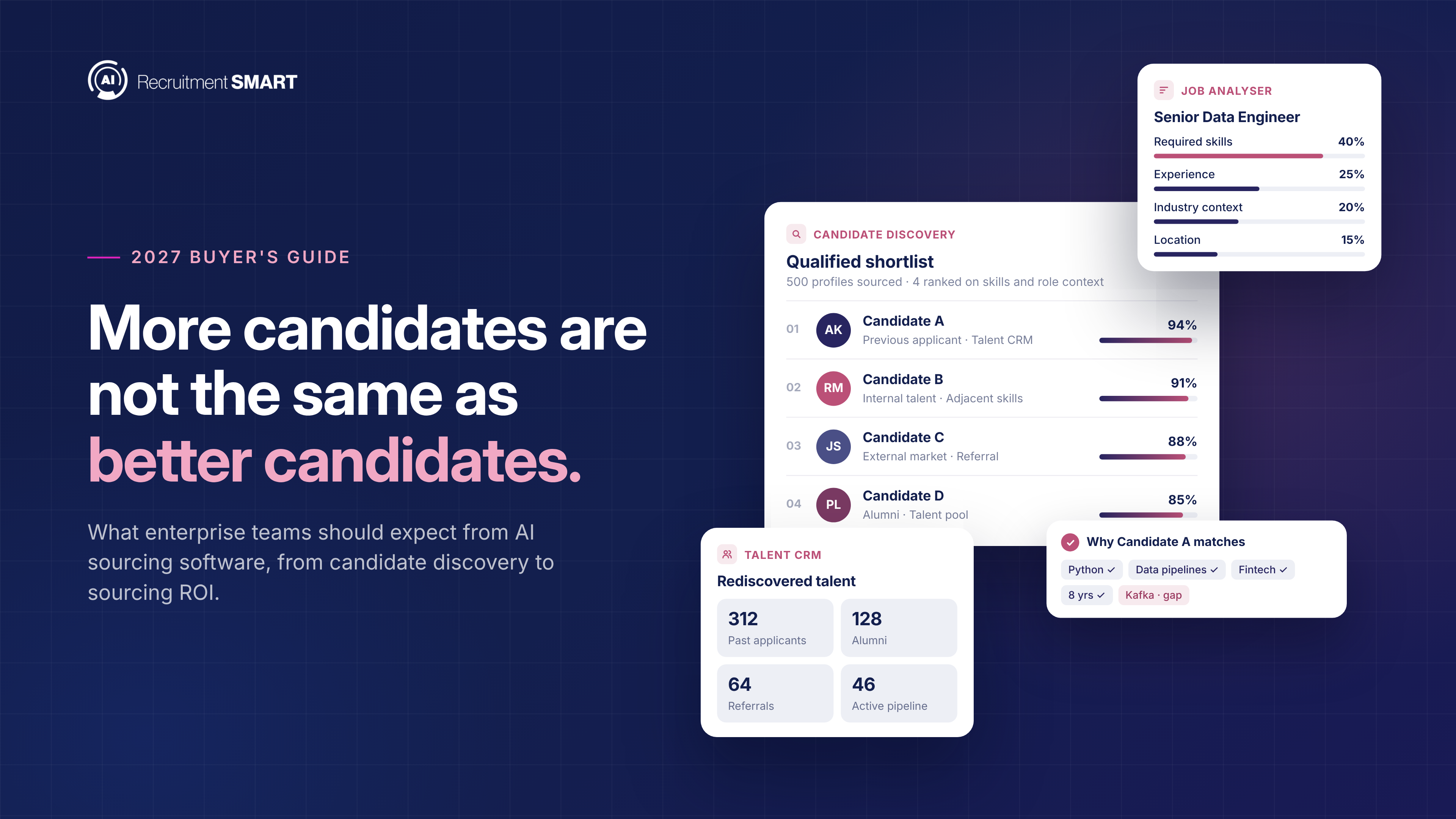
Recruitment Smart’s Job Analyser extracts role parameters from a job description and allows recruiters to adjust the weighting of requirements. The platform also provides a breakdown of how candidate scores are produced.
That creates an important principle: sourcing quality begins with requirement quality.
Why are more candidates not necessarily producing better hiring decisions?
More candidate volume can simply move the bottleneck further down the recruitment funnel.
Imagine an AI tool produces 500 potential profiles instead of 100. If recruiters still have to manually review most of them, the organisation has not solved the decision problem.
It has created a larger one.
This is why enterprise buyers should distinguish between activity metrics and outcome metrics.
This distinction is becoming more important as AI adoption grows.
AIHR’s 2027 research argues that AI use itself will not be a meaningful differentiator for most organisations. The harder problem will be proving that AI improves performance, quality or decision-making.
For sourcing teams, that means “profiles sourced” is a weak endpoint.
How does AI change the reliability of candidate information?
As candidates use more AI, recruiters need stronger signals than the CV alone.
The iCIMS and Aptitude Research 2026 study found that 74% of companies report candidates using AI in their job search.
This does not make CVs useless. It changes what they can reliably tell you.
A polished CV may show that someone can present their experience well. It does not necessarily show how they will perform in the role.
LinkedIn’s 2026 Future of Talent research found that recruiter conversations about trust doubled year over year, covering authenticity, candidate verification and separating signal from noise. It also identifies skills verification and proof of capability as increasingly important signals.
That creates a new sourcing requirement. AI should not only answer “Who matches this job?” It should help answer “What evidence tells us this person is relevant?”
That can include skills, experience, role context, previous interactions, assessments and other structured signals.
Should companies search their existing talent before going to the external market?
Yes, when relevant capability may already exist inside the organisation or its existing talent ecosystem.
A company may already have:
- previous applicants
- employee referrals
- alumni
- passive candidates
- internal employees
- candidates considered for other roles
- people with adjacent skills
Yet many organisations treat this information as historical data rather than usable talent. That creates an expensive pattern, when a more intelligent model is available:
Recruitment Smart’s Candidate Discovery is designed around this rediscovery model, helping recruiters identify relevant candidates from existing recruitment data.
Our Talent CRM goes further by bringing together candidate segments such as alumni, referrals, previous applicants and active pipelines, with capability modelling and candidate relationship data.
This changes the economics of sourcing. The question is no longer only “How much access do we have to external candidates?” It becomes “How much of the talent we already paid to attract can we actually reuse?”
What should an enterprise AI sourcing platform be able to do?
An enterprise platform should connect role understanding, candidate discovery, evidence, human control, workflow and measurement.
Use this framework when comparing vendors.
The human-control point is especially important.
SniperAI is designed to assist with sourcing, screening, ranking and insights, while final hiring decisions remain human-driven. The platform also provides explainable recommendations, matching insights and scoring logic.
That distinction matters as AI becomes more capable. Automation should reduce repetitive work. It should not remove accountability from consequential decisions.
Why should AI sourcing connect to screening instead of ending at the shortlist?
Because the value of sourcing is realised only when relevant candidates progress through the hiring process.
A disconnected sourcing tool creates another handoff. Every handoff is another opportunity for delay, data loss or duplicate work.
Recruitment Smart’s broader SniperAI platform connects sourcing and screening capabilities within this recruitment workflow. Its current product ecosystem includes candidate discovery, talent CRM, job analysis and screening capabilities.
This is also why the enterprise buyer should ask a vendor: “What happens after your AI finds the candidate?”
That question can reveal whether the product is solving a workflow problem or only a search problem.
What does one of the industry’s largest engineering and technology services organisations show about the future of talent sourcing?
Better talent intelligence can reduce dependence on external hiring.
One of the industry’s largest engineering and technology services organisations had thousands of engineers working across complex programmes.
The organisation already had talent. Its problem was visibility.
Workforce decisions relied heavily on resumes, historic project experience and manager input. Leadership lacked a reliable way to assess current skills across the workforce at scale.
The organisation introduced a structured skills assessment layer aligned with real project requirements. The results included:
- 4,000+ engineers assessed within weeks
- 30% of open roles filled through internal redeployment
- 1,200+ engineers identified for targeted upskilling
- Nearly 70% reduction in interview panel effort
The important lesson is not simply that technology enabled the assessment of thousands of engineers. It is that the organisation changed the question from “Who do we need to hire?” to “Where does the capability we need already exist?”
That is a significant shift in how talent sourcing can evolve. The candidate is not always the only unit of search. Capability is.
4,000+ engineers assessed. 30% of open roles filled internally.
See how an industry-leading organisation moved from assumption-based workforce decisions to evidence-backed talent allocation.
When is AI sourcing software actually worth buying?
AI sourcing software is worth evaluating when candidate discovery and qualification are consuming meaningful recruiter capacity or producing inconsistent results.
It is a strong candidate for investment when:
- recruiters spend significant time searching
- specialist skills are difficult to find
- sourcing produces too many weak profiles
- historical candidate data is underused
- hiring volumes fluctuate sharply
- recruiters need better candidate prioritisation
- sourcing and screening are disconnected
- the organisation needs to search across multiple talent pools
- hiring leaders want more evidence behind candidate recommendations
But AI sourcing may not be the first problem to solve when:
- the role itself is poorly defined
- candidate data is fragmented or unreliable
- recruiters do not agree on what a good candidate looks like
- the recruitment workflow is broken elsewhere
- nobody owns AI governance
- the organisation has no agreed definition of success
This is an important buying distinction: do not automate an undefined problem.
How should companies measure AI sourcing ROI?
AI sourcing ROI should be measured by qualified candidates and downstream hiring outcomes, not only by hours saved.
A practical measurement framework includes:
LinkedIn’s 2026 Future of Talent research points to the same measurement shift. Among its AI-frontier talent leaders, quality of hire remains the top priority, while metrics increasingly extend beyond the hire to business impact, time to productivity, internal fill rates and talent lifecycle health.
That is the measurement standard AI sourcing should move towards.
What will AI sourcing look like in 2027 and beyond?
AI sourcing will move from assisted search towards AI-coordinated talent workflows, while human judgment remains responsible for consequential decisions.
The progression is already visible.
AIHR’s 2027 research also describes a shift from AI assisting individual tasks towards humans and AI contributing different parts of the same workflow. The challenge becomes deciding where human review is required and who remains accountable.
That means the future sourcing platform will need more than a search engine. It will need:
- connected data
- clear permissions
- explainable recommendations
- human controls
- workflow integration
- governance
- measurable outcomes
How should enterprise buyers prepare their recruitment stack for agentic sourcing?
Enterprises should build the foundations for AI agents before giving them more autonomy. That means getting the basics right first.
1. Define roles clearly
AI cannot make a vague hiring requirement precise by itself.
2. Connect candidate data
Historical applicants, CRM records, internal talent and external sources should not remain isolated.
3. Integrate the workflow
Sourcing should connect to screening, assessment and hiring decisions.
4. Keep humans accountable
Recruiters and hiring leaders should know when AI is recommending, acting or escalating.
5. Preserve decision evidence
AI-supported decisions should be reviewable.
6. Measure outcomes
Set the baseline before automation begins.
7. Design for change
The technology stack should support new AI capabilities without requiring a new system for every new task.
This is where the difference between an AI tool and an AI recruitment architecture becomes important.
How does Recruitment Smart fit into this model?
Recruitment Smart positions AI sourcing as part of a connected talent intelligence and recruitment workflow rather than as a standalone search function.
Our current product ecosystem includes:
- Job Analyser for structured role and candidate scoring
- Candidate Discovery for talent rediscovery
- Talent CRM for talent intelligence and relationship management
- Sourcing & Screening Automation for sourcing and screening workflows
Guided by our AI governance standards, we use semantic matching to provide explainable insights while keeping humans at the heart of every hiring decision.
For an enterprise buyer, that makes the more relevant question: can sourcing become part of a connected decision system? That is the direction Recruitment Smart’s platform is designed to support.
Explore Recruitment Smart’s AI sourcing and screening platform →
The 2027 AI Recruitment Technology Checklist
Before buying another AI recruitment tool, evaluate:
- Candidate quality
- Talent rediscovery
- Contextual matching
- Explainability
- Human oversight
- ATS integration
- Workflow connectivity
- ROI measurement
- AI governance
The next sourcing advantage will not be a bigger database
The question facing recruiting teams in 2027 is no longer whether AI can find candidates. It can.
The harder question is whether your organisation can turn all that available talent data into better hiring decisions.
That requires more than a larger candidate pool. It requires a clear understanding of the role, the ability to identify relevant capability across internal and external talent, evidence behind candidate recommendations, and a workflow that carries those insights into screening and hiring.
It also requires knowing where AI should act and where recruiters should remain firmly in control.
The organisations that get this right will not measure sourcing success by how many profiles their technology can produce. They will measure it by how quickly they can find qualified capability, make confident decisions and convert that capability into business outcomes.
That is the shift from AI-assisted sourcing to intelligent talent discovery. And it is the standard worth applying to every sourcing technology decision you make for 2027.
See how Recruitment Smart connects candidate discovery, AI sourcing, screening and talent intelligence in one recruitment workflow.
Book a 1:1 with Recruitment Smart