





TL;DR
The debate over asynchronous versus live interviewing is settled: most enterprise teams use both. The harder problems now are AI-inflated application volume, candidates using AI in interviews, inconsistent live assessment, new legal duties on AI in hiring, and candidate trust. Use asynchronous screening for scale, structured live interviews for depth, integrity checks throughout, and keep the final decision with a person.
The Format Question Is Settled. The Problems Are Not.
Most enterprise talent teams no longer debate whether to use video or AI interviews. Some mix of one-way screening, AI-led interviewing and structured live interviewing is already in the stack.
What has changed is the environment those tools work in. Candidates now use AI to write and submit applications at scale. Many bring AI into the interview itself. Rules on AI in hiring have moved from proposals to obligations in several major markets. And recruiting teams are being asked to hire well with fewer people.
So the useful question is no longer “async or live?” It is: which problem are we solving at each stage, and does our interview process actually solve it?
This guide covers five of those problems, what good looks like for each, and how Recruitment Smart’s VScreen approaches them in practice.
The Three Formats in 60 Seconds
If you work in talent acquisition, you know these already. Here is a quick recap so the rest of the guide uses shared terms.
Two points matter more than the labels. First, timing and structure are separate questions: an asynchronous interview can be as structured as a live one, often more so. Second, AI Avatar interviews are asynchronous for the hiring team but real-time for the candidate, which is why they sit between the other two.
Problem 1: Application Volume Has Outrun Recruiter Capacity
Generative AI has made applying almost effortless. Candidates can tailor a CV and cover letter in minutes, and auto-apply tools submit to dozens of roles at once. For recruiters, that means more applications per role and less signal in each one.
Why the resume stopped being a reliable first filter
When most applications are well written, keyword-matched and tailored to the job description, the resume stops separating candidates. Screening on it either rejects good people for arbitrary reasons or passes too many through to recruiter calls.
The answer is not a stricter resume filter. It is collecting better evidence sooner.
Moving real evidence earlier in the funnel
An asynchronous first screen built on the job description gives every applicant the same role-relevant questions, without anyone booking a call. Recruiters review answers and AI-generated ratings in batches, and only candidates with evidence of fit move on.
Two design choices make the difference:
- Test application, not recall. Questions should ask how a candidate would handle situations the role actually involves, not facts they could look up.
- Break evaluation into named parameters. A recruiter should be able to see why a candidate scored as they did, not just the overall score.
When conversation is worth adding at the screening stage
For roles where communication, reasoning or customer handling matter from day one, recorded answers to fixed prompts can miss what you need. An AI Avatar interview adds a real-time conversation without adding a recruiter’s calendar slot.
The trade-off is comparability. The AI’s follow-up questions should stay anchored to the same competencies for every candidate, so scores remain fair and comparable.
In practice: VScreen’s asynchronous workflow starts from the job description. AI generates role-specific questions, candidates are invited in bulk, and recruiters review responses alongside parameter-level insights before results flow into the ATS. Recruitment Smart reports this can cut screening time by 80% and save 20+ recruiter hours a week. These are vendor-reported figures, not independent benchmarks.
Problem 2: Candidates Are Using AI Too
Hiring teams adopted AI to assess candidates. Candidates adopted it to get through assessments. The two trends now meet inside the interview.
From polished scripts to real-time interview copilots
Preparing with AI is normal and often fine. The concern is live assistance: tools that listen to a question and put a ready-made answer on the candidate’s screen.
Recruiters describe consistent warning signs: answers that sound read rather than spoken, a pause before every response, near-identical phrasing across candidates, and strong first answers that fall apart under a follow-up question.
Deepfakes and identity fraud in remote hiring
A smaller but more serious problem is candidates who are not who they claim to be: proxy interviewees, manipulated video and fraudulent applicants targeting remote roles. Gartner has predicted that by 2028, one in four job candidates globally could be fake.
For roles with access to systems, customer data or funds, an interview that cannot confirm identity is a security gap, not just a hiring one.
Designing interviews that hold up
No single detection tool solves this. What works is layered design:
- Ask questions AI can’t answer for them. Applied scenarios tied to the role, and questions about the candidate’s own past work.
- Follow up. A second question that probes the first answer quickly shows whether the understanding is real, whether a human or an AI interviewer asks it.
- Verify identity at defined points. At the screen, and again before an offer.
- Keep a live checkpoint. A structured live interview before the offer confirms that the person you assessed is the person you hire.
- Set a clear policy. Tell candidates what AI use is acceptable, such as preparation, and what isn’t, such as live assistance. Many teams are moving from “ban AI” to “define acceptable AI use”.
In practice: VScreen layers integrity checks into asynchronous screening, uses AI Avatar follow-up questions to test understanding, and makes the AI-Structured live interview a verification checkpoint before the hiring decision.
Problem 3: Consistency Still Breaks Down at the Live Stage
Most organisations have standardised their first screen. Far fewer have standardised what happens next, and that is where most hiring decisions are actually made.
Panel drift
Two interviewers can assess the same candidate for the same role and ask different questions, weight different skills and hold different bars. Across a large panel, that drift adds up to unfair outcomes and decisions that are hard to defend.
Interviewer training helps, but it fades without tools that keep the structure in front of interviewers during the conversation itself.
What structure looks like in a live conversation
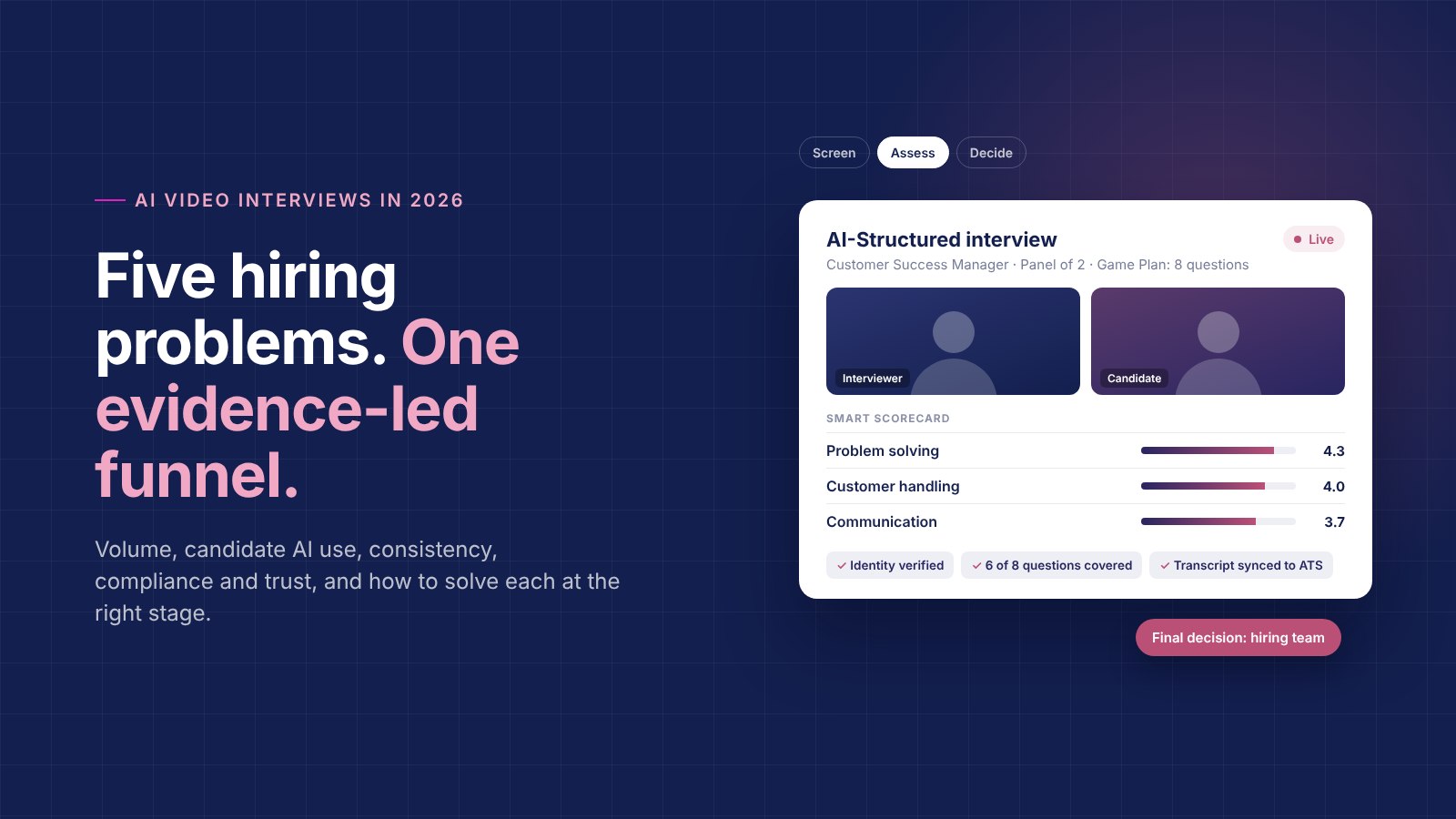
A structured live interview keeps human judgement and removes the guesswork around it:
- A shared blueprint of role-relevant technical and behavioural questions
- Guidance in front of the interviewer, with candidate context and prompts
- Tracking of which planned questions have been covered
- Scorecards with defined parameters, applied the same way by every interviewer
- Calibration across panels, by comparing scores against the evidence behind them
Turning interviews into evidence, not memories
A debrief built on recollection favours whoever speaks first and remembers most. Transcripts, timestamped notes and short clips let a hiring manager review what a candidate actually said, and let a panel disagree about evidence rather than impressions.
In practice: VScreen’s AI-Structured interviews use QuestAI to build a Game Plan from the job description, give interviewers Real-Time Guidance and Question Tracking during the call, apply a Smart Scorecard afterwards, and sync transcripts, clips and scores into the ATS. Book a Live Tour →
Problem 4: AI in Hiring Now Has to Be Explainable and Auditable
Using AI to assess candidates now comes with legal obligations in several major markets. The details differ, but the direction is consistent: disclose, explain, test for bias and keep a human accountable.
The regulatory picture in late 2026
- European Union: The AI Act classifies AI used to recruit and evaluate candidates as high-risk. That brings duties on risk management, data quality, human oversight, transparency and record-keeping. Under the EU’s Digital Omnibus on AI, these obligations now apply from 2 December 2027 rather than August 2026.
- New York City: Local Law 144 requires an independent bias audit and candidate notice before using automated employment decision tools.
- Illinois: Amendments to the Illinois Human Rights Act, effective January 2026, prohibit discriminatory use of AI in employment decisions and require notice. The state’s AI Video Interview Act already governs consent and data handling for AI-analysed video interviews.
- Colorado and California: Colorado’s revised AI law, which takes effect in January 2027, and California’s regulations on automated-decision systems add further duties for consequential hiring decisions.
The practical message for buyers: if a vendor cannot explain how its scores are produced and tested, the compliance risk sits with you.
Explainable scoring and the human in the loop
A single overall score is hard to defend. Scores broken into named parameters, and linked to the questions and answers behind them, let a recruiter see and challenge the reasoning.
Just as important is the decision rule. AI recommends and organises the evidence; a person decides, and that decision is recorded.
Bias testing as an ongoing practice
Bias is not checked once at procurement. Pass rates should be monitored by stage and by group over time, questions reviewed for job relevance, and scoring adjusted when adverse impact appears. Ask vendors how often they test, on what data, and what they share with customers.
In practice: VScreen is built around the VISTA framework: Vision, Interest, Salary, Technology and Availability. We follow the principle of traceability, where everything can be tracked and traced: scores tied to the questions, responses and parameters behind them, with the final decision left to the hiring team.
Problem 5: Candidates Judge Your Brand by the Interview
For many candidates, the interview is their first real contact with your organisation. AI can make that contact faster and fairer, or it can make candidates feel processed by a machine.
When AI interviewers help and when they hurt
Candidates generally value flexibility: interviewing in the evening or from home, without rearranging their working day. They value it far less when the process feels opaque, when nobody explains what happens next, or when a senior candidate never speaks to a person.
A sound rule: use AI to remove waiting and scheduling, and make sure every candidate who progresses meets a human before an offer.
The transparency candidates now expect
Tell candidates where AI is used, what it assesses and who makes the decision. In several jurisdictions this is a legal requirement, but it also builds trust. Candidates engage more readily with an AI interviewer when they understand what it is for.
Accessibility, language and fairness
Assessment should measure the skills the role needs, not accent, camera confidence or the quality of someone’s home internet. In practice, that means:
- Reasonable adjustments, offered clearly and granted on request
- Enough preparation and response time
- Interviews in the candidate’s working language where the role allows
- Monitoring whether scores differ by accent or first language
In practice: VScreen’s asynchronous interviews let candidates respond on their own schedule, with configurable preparation and response times. Recruitment Smart reports a 65% increase in interview completion.
Putting It Together: A Funnel Built Around Problems, Not Formats
Each problem points to a different tool at a different stage. Together, they form a funnel where scale comes first, depth comes later, and accountability runs throughout.
How to adjust by role:
- High-volume roles (customer service, retail, graduate intake): a one-way screen, then a short AI-Structured interview for the shortlist.
- Technical roles: a one-way or AI Avatar screen built on applied questions, then a deeper AI-Structured technical interview.
- Leadership roles: skip AI-led screening and go straight to AI-Structured interviews with a calibrated panel.
Questions to Ask Any AI Interview Platform in 2026
Use these in demos and RFPs. A strong platform answers them with evidence, not adjectives.
Volume
- Can questions be generated from our job descriptions, and can we review and edit them before use?
- Can recruiters assess hundreds of responses without watching every video in full?
Integrity
- How does the platform detect live AI assistance, and how does it verify identity?
- What happens when it flags a concern, and who reviews the flag?
Consistency
- How are live interviewers kept to the same questions and scoring criteria?
- Can we compare scores across interviewers and panels?
Compliance
- Can you show exactly how a candidate’s score was produced?
- How often do you test for adverse impact, and will you share the results?
- How do you support candidate notice and consent in the jurisdictions where we hire?
Candidate experience
- What do candidates see about how AI is used?
- Which adjustments and languages are supported?
Solve the Problem, Then Pick the Format
The interview formats are well understood. The problems around them are newer and harder:
- Volume: collect real evidence earlier, without calendars.
- Integrity: design interviews that hold up when candidates use AI.
- Consistency: bring structure to live interviews, where most decisions are made.
- Compliance: make every AI-assisted score explainable and auditable.
- Trust: be open with candidates about how they are assessed.
Get those right, and the choice of format at each stage becomes straightforward.
The video was never the product. The evidence it produces, and the decisions that evidence supports, are.
From asynchronous screening to AI-Structured live interviews, see VScreen on your own roles.
Book a demo with Recruitment Smart